Whether introduced intentionally or accidentally, invasive alien species are today among the main threats to global biodiversity. In the French Caribbean, several species of freshwater turtles introduced over time have successfully established themselves in natural environments, sometimes to the detriment of native species. Understanding their distribution and impact is therefore essential to implement effective management actions.
Launched in 2024, the DEVIMTOR project, coordinated by Caribaea Initiative and funded by the Office français de la Biodiversité, the Office de l’eau de Guadeloupe, and the Office de l’eau de Martinique, aims to improve knowledge and reduce the impact of these exotic turtles in the aquatic environments of Guadeloupe and Martinique.
The video below (EN subtitles available) features Christopher Cambrone, the project’s scientific coordinator, who discusses the objectives, challenges, and ongoing actions carried out as part of the project.
In Guadeloupe: fieldwork well underway
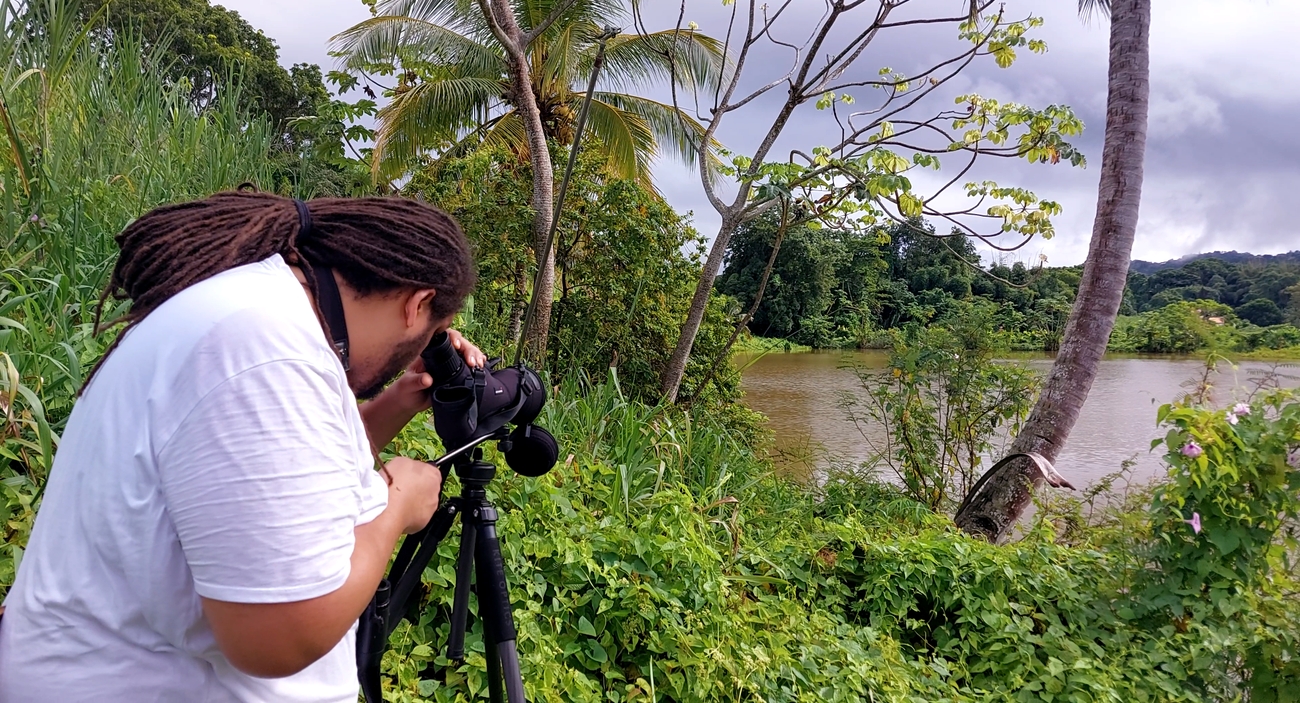
The first phases of the project focused on Guadeloupe, where extensive mapping identified 172 ponds, of which 54 were ultimately selected for sampling. The fieldwork, led by Mirella Morgene and Jérémy Eudleur, two young technicians fully dedicated to the project, is now well advanced. In the selected ponds, sediment has been collected and environmental DNA (eDNA) extracted to search for traces left by turtles—an innovative method that allows species to be detected without capturing them.
Water samples have also been collected for the same purpose. The initial protocol had to be adapted to local conditions, characterized by the high turbidity typical of tropical environments. After several trials, a new filtration method was developed, proving more effective at capturing the DNA fragments left in the water by turtles. Laboratory analyses are ongoing, and the results will be compared with other data collected from the sites, including their ecological and physico-chemical characteristics.
In Martinique: sampling planned in the coming weeks
In Martinique, more than 200 ponds have been identified and mapped. Around one hundred have been selected based on their accessibility and ecological interest, and access authorization requests are currently underway.
Field missions will begin by the end of the year, with the support of our local partner, Nathalie Duporge. The team will be responsible not only for collecting water and sediment samples but also for characterizing the environment of each site (vegetation, depth, temperature, pH, presence of birds and odonates, etc.), in order to obtain a comprehensive view of the habitats used by invasive turtles.
What’s next?
Genetic analyses, conducted from the water and sediment samples collected in both territories, will identify the invasive turtle species present at each site. Additional genetic analyses will focus on the stomach contents of individuals captured in Guadeloupe and Martinique, providing valuable insights into their diet and their impact on local biodiversity. In parallel, GPS tags will soon be installed on several individuals to track their movements and better understand their behavior.
Together, these data will provide essential knowledge to better understand the population dynamics of invasive turtles in the Caribbean and their impact on local biodiversity.