
Caribbean biodiversity is not limited to brightly colored birds or tropical fish. It also includes a multitude of microscopic organisms, such as parasites, whose study is just as important from both an ecological and an economic perspective.
Among the many parasites that inhabit our planet, those of the genus Nematopsis live almost exclusively in the marine environment and generally have what is known as a complex life cycle: they pass through several successive hosts during their lifetime. While reproduction takes place in a crustacean, it is in a mollusk that the parasite develops, in the form of oocysts lodged within the tissues.
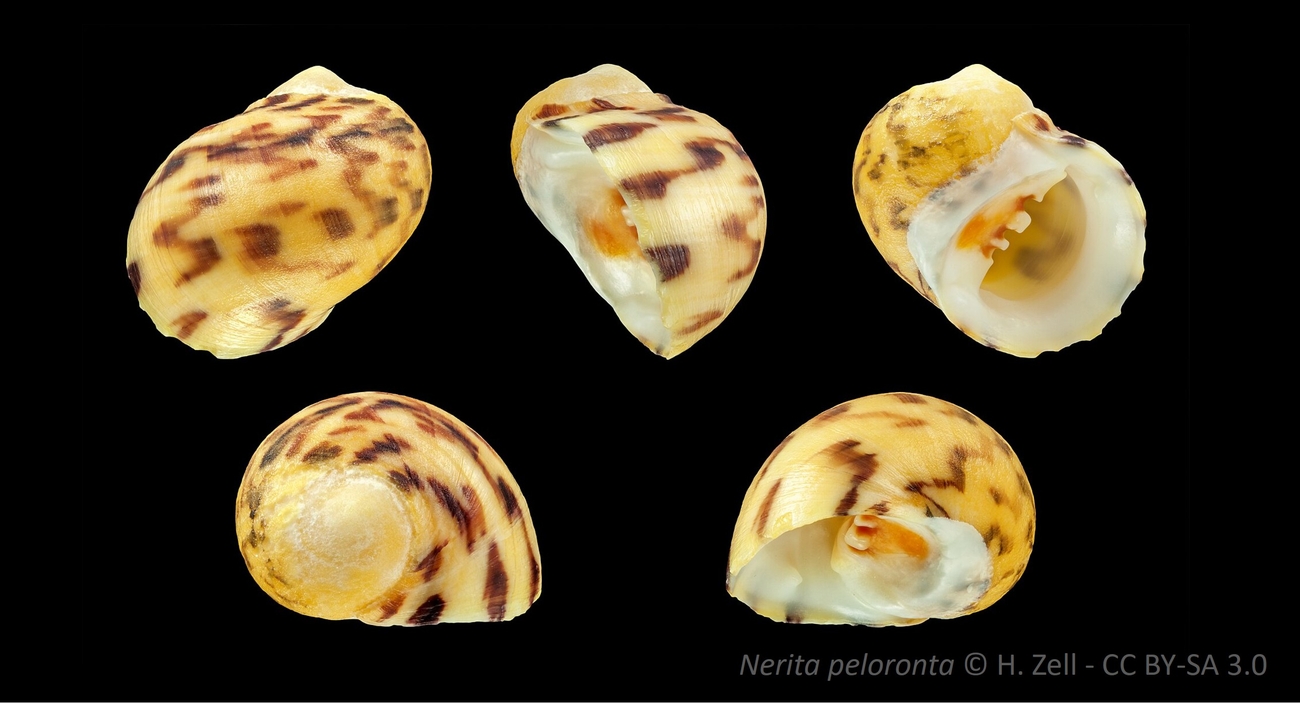
Until now, these parasites were mostly known for infecting bivalve mollusks such as oysters, mussels, or scallops, sometimes with serious consequences for fisheries. But a recent study led by Nicole Herbert, one of the very first students supported by the association during her PhD and now Secretary General of Caribaea Initiative, revealed their presence in nerite gastropods, small marine snails with colorful shells living on coastal rocks.
From field to laboratory
Nerita versicolor © James St. John – CC BY 2.0
In this study, marine snails of two nerite species (Nerita peloronta and Nerita versicolor) were collected on the coasts of Saint Kitts. The animals were dissected in the laboratory to examine their tissues under the microscope, looking for signs of infection by Nematopsis. Histological analyses (stained tissue sections) allowed visualization of the oocysts inside the host’s cells.
The researchers also extracted DNA from infected tissues to confirm the parasite’s identity through molecular analyses. To do this, they designed new genetic tools (specific primers) that make it possible to target the DNA of these parasites.
Finally, the obtained sequences were compared with those of other Nematopsis found in scallops from Argentina, Scotland, and Florida, which helped clarify their position within the phylogenetic tree of the group.
An unexpected host
When examining the 127 collected nerites of the two species, the researchers found that 78.6% of the individuals of the species N. peloronta and 100% of those of the species N. versicolor were infected by Nematopsis. Other marine snails collected from the same sites, belonging to four different species, were free of infection. This result suggests that nerites may represent an exception among gastropods, possibly being the only group of marine snails capable of hosting this parasite, generally associated with bivalves.
An ecological and economic impact
Although nerites are not a resource for Caribbean fisheries, they nevertheless play a role in the functioning of tropical ecosystems. Moreover, their infection by Nematopsis shows that these parasites are able to colonize hosts not previously known, raising the question of their presence in other mollusks of the region, particularly in species such as the queen conch (Strombus gigas) or the West Indian top shell (Cittarium pica), which have major economic importance. In addition, many Nematopsis use commercially important crustaceans as definitive hosts. Identifying which crustacean species serves as the definitive host in Saint Kitts will therefore be a key step in better understanding the parasite’s life cycle and its ecological as well as economic impact.
Reference
Herbert, N.A.M., Kristmundsson, Á., Vazquez, N., Hoag, K. & Freeman, M.A. (2025). Nematopsis Schneider, 1892 in Nerite gastropods from Saint Kitts, with a phylogenetic study of the genus, and placement within the phylum Apicomplexa Levine, 1970. Journal of Eukaryotic Microbiology 72:e70023.