
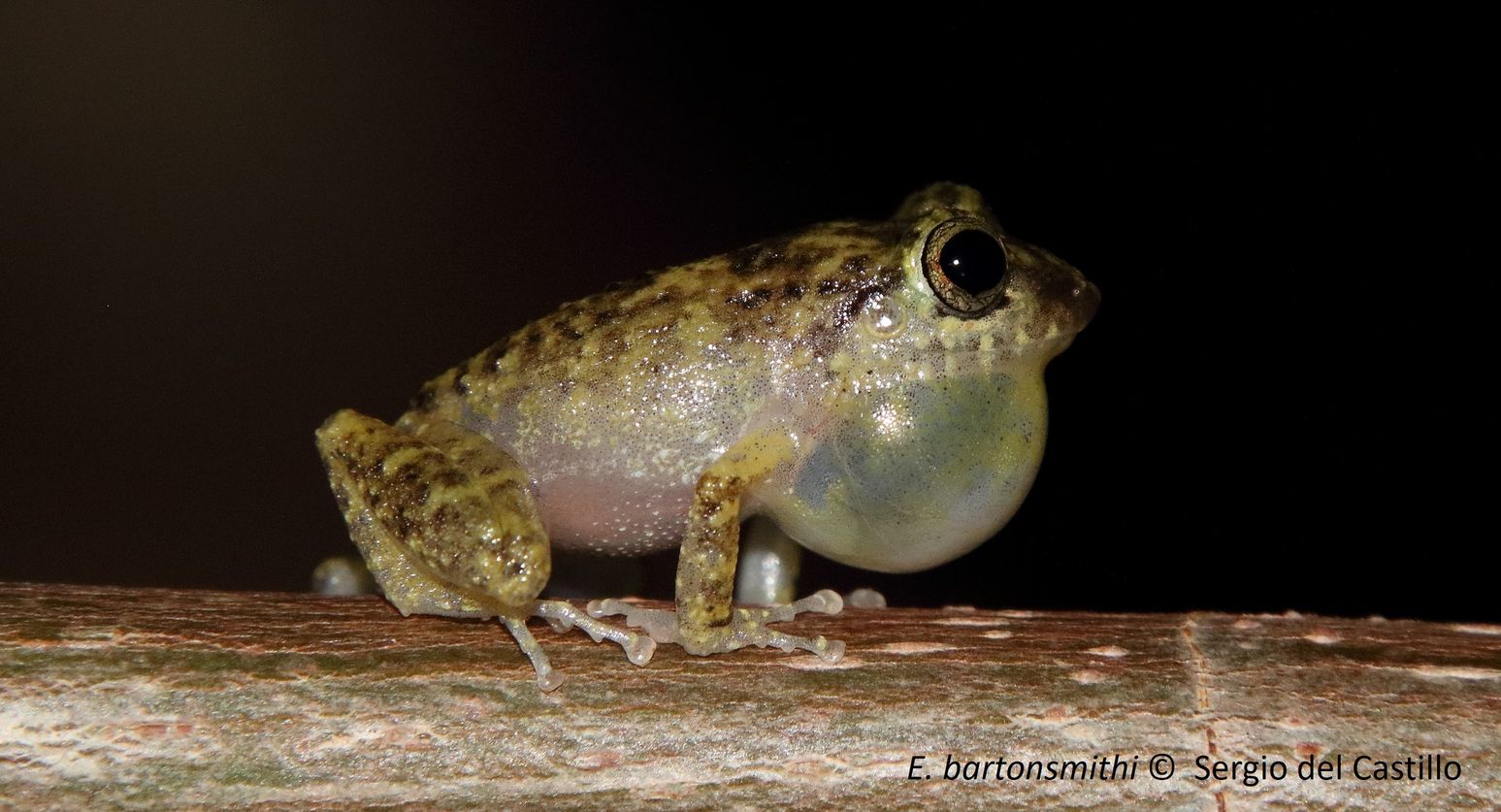
What if listening to the forest could help us protect its most elusive inhabitants? In Cuba, a tiny frog with a very restricted range—Eleutherodactylus bartonsmithi—has become the focus of an innovative conservation study based on sound.
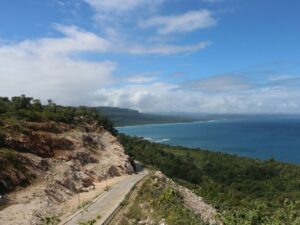
The newly constructed road cutting through the Yumurí forest. © Sergio del Castillo
The little Cuban frog Eleutherodactylus bartonsmithi, found only in a small forested area near the Yumurí River Canyon, was already known to be Critically Endangered. But following a major hurricane and the construction of a 4.5 km road through its habitat, scientists feared for its survival. To assess the situation, Caribaea Initiative-supported student Mariam Curbelo Cruz led a study using a non-invasive technique: passive acoustic monitoring.
Using sound to study biodiversity
Passive acoustic monitoring involves placing sound recorders in the field to capture natural sounds over long periods. These devices record all the surrounding soundscapes, including animal vocalizations. The data can then be analyzed to detect specific species or assess their activity levels.
Several projects led or supported by Caribaea Initiative have been using these tools recently. For example, in the ESPACYPA project, dedicated to the study of bird communities in Guadeloupe and Martinique, dozens of autonomous recorders have been deployed across various habitats. They help us detect elusive birds, monitor their seasonal patterns or record their distribution. Combined with other tools like camera traps, acoustic monitoring provides a powerful, non-intrusive way to study wildlife.
In Mariam’s study, five recorders were installed in different parts of the frog’s known habitat and operated during three distinct months (February, June, and October).
Findings and observations
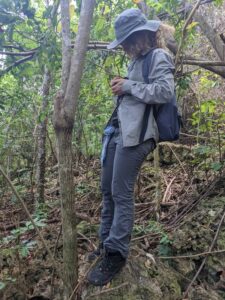
Mariam Curbelo Cruz adjusting an acoustic recorder during fieldwork in Cuba.
The analysis revealed that the frog’s vocal activity peaked in October, especially at dawn between 5:00 and 7:00 AM, when males formed powerful choruses to attract mates.
Surprisingly, the highest levels of activity were recorded near the newly built road. This suggests that the frog may be more tolerant of habitat disturbance than previously thought, or that edge habitats might offer favorable conditions—an observation that warrants further investigation.
This research, based on Mariam’s research during her master’s studies, represents the first use of soundscape analysis to monitor a Critically Endangered amphibian in Cuba. Beyond providing new data on E. bartonsmithi, it sets the stage for broader conservation efforts using acoustic tools—whether to monitor other amphibians or completely different species from the Caribbean.
References
Curbelo Cruz, M., del Castillo Domínguez, S., Machado, L.G., Herrera Rodeiro, A. Mancina, C.A., Bosch, R.A. (2025). A soundscape approach for a short-term acoustic monitoring of a critically endangered Cuban frog. Biodiversity and Conservation, https://doi.org/10.1007/s10531-025-03056-3.