
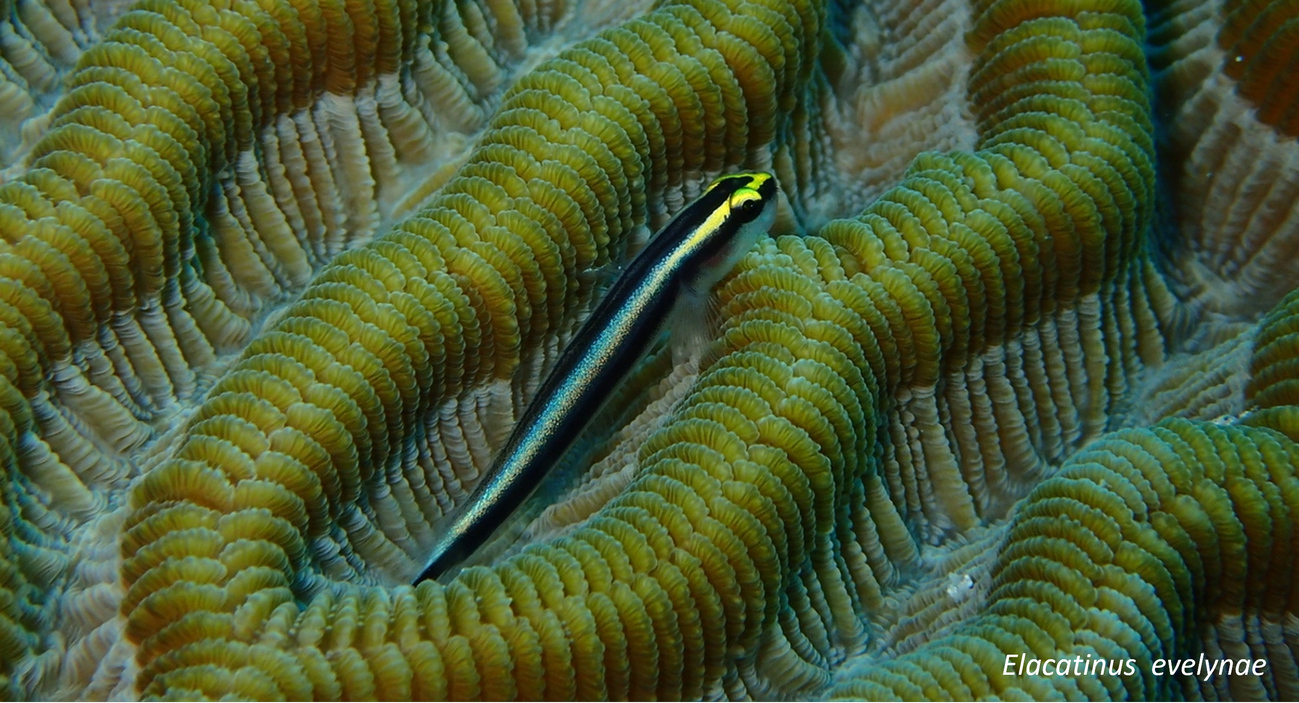
Two tiny fish species with remarkably similar lifestyles inhabit the reefs of Barbados. Although they are often found on the same reefs and exploit comparable resources, they manage to coexist over the long term. A study led by Jeniece Germain provides new insights into the mechanisms that make this coexistence possible.
Cleaner gobies of the genus Elacatinus are small reef fishes that act as “cleaner fish”: they feed primarily on parasites and dead skin removed from larger fish. In the Caribbean, Elacatinus evelynae and Elacatinus prochilos are frequently observed on the same reefs.
To understand how such coexistence is possible, Jeniece Germain conducted a detailed study of a goby population in Barbados as part of her master’s research project, carried out with support from Caribaea Initiative and supervised by Henri Vallès.
A full year of underwater observations
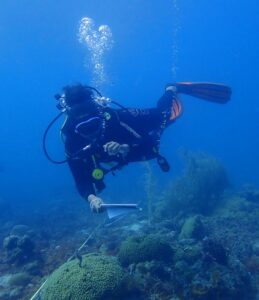
Jeniece Germain conducting fieldwork
The study took place within a 900 m² reef area located between 8 and 11 metres deep. The researchers mapped all massive corals and barrel sponges present at the site and then monitored goby populations for nearly a year. A total of 90 survey sessions were conducted, corresponding to an average visit every four days. During each dive, the researchers systematically surveyed the entire study area in order to count individuals of both fish species present on each coral and sponge.
This approach made it possible to track population changes throughout the seasons while also assessing how the two species used the different microhabitats available.
Clear differences in habitat preferences
During the study, 37,260 goby observations were recorded. This impressive amount of data shows that the two species do not use habitats in the same way.
E. evelynae was observed primarily on massive corals. Most individuals lived alone or in pairs and preferentially occupied coral colonies. In contrast, E. prochilos was much more frequently found in barrel sponges. Individuals often formed groups of several fish, sometimes composed of more than ten individuals.
Over the entire study period, E. evelynae was approximately one and a half times more abundant on corals than on sponges, whereas E. prochilos was nearly ten times more abundant in sponges than on corals. These differences were observed throughout the year despite substantial natural fluctuations in population size.
Coexistence facilitated by spatial partitioning
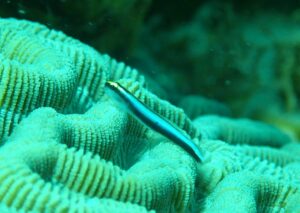
Elacatinus evelynae, one of the two species studied
The researchers also sought to determine whether the presence of one species directly influenced the distribution of the other.
Their analyses revealed no major effect of one species’ density on the other’s habitat use. However, when E. evelynae populations reached their highest levels, a greater proportion of individuals was observed in sponges. This result suggests that coral habitat may become locally limiting when population densities increase.
Improving our understanding of Caribbean coral reefs
Cleaner gobies play an important role in reef communities and contribute to the many interactions that structure coral reef ecosystems. Understanding the factors that determine their distribution helps improve our understanding of reef functioning and how species respond to changes in habitat availability.
These findings are particularly relevant in the Caribbean, where coral reefs face multiple pressures, including climate change, which is driving increasingly frequent coral bleaching events.
Reference
Germain, J. & Vallès, H. (2026). Co-existence of two sympatric Caribbean cleaner gobies is driven by spatial partitioning due to contrasting microhabitat preferences. Marine Ecology Progress Series 780: meps15074. https://doi.org/10.3354/meps15074.