
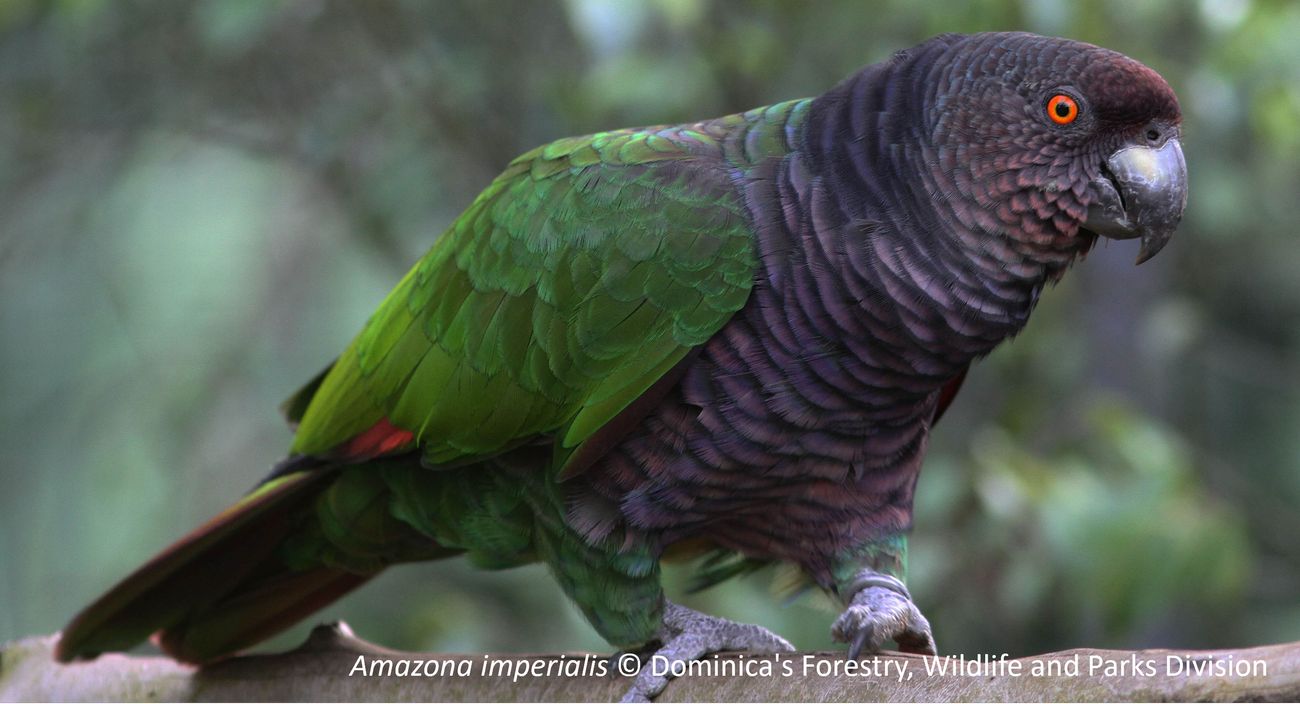
Caribaea Initiative and its partners are working in Dominica to strengthen the conservation of the Imperial Amazon (Amazona imperialis), locally known as the Sisserou. This summer, the project moved forward on several fronts, from field monitoring to conservation education with young people.
Endemic to Dominica, the Sisserou is the country’s national bird and is classified as Critically Endangered. Together with the Red-necked Amazon (Amazona arausiaca), locally known as the Jaco, it is one of the island’s two endemic parrot species. Through the SCCS project, Caribaea Initiative and its partners are working to improve knowledge of these remarkable birds while strengthening local capacities, education and involvement in their conservation.
P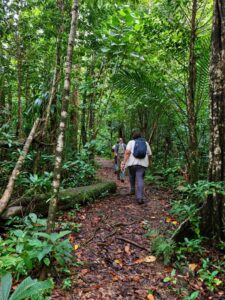 reparing parrot monitoring in the field
At the end of July, a Caribaea Initiative team travelled to Dominica to meet with local partners and prepare the next stages of the project.
The mission gave us the opportunity to join the local team directly in the field and further refine the protocol that is being used to monitor Dominica’s two endemic parrots. Several monitoring locations were visited and the practical aspects of surveys were discussed with staff from the Forestry, Wildlife and Parks Division.
Fieldwork also brought one of those moments that make conservation work particularly rewarding: during the visit, we had the chance to observe several Jacos flying in the forest — and to hear the unmistakable call of a Sisserou.
The mission helped the different partners agree on the approach to be used in the coming months and fine-tune the methods needed to develop long-term monitoring of these species.
Preparing a summer dedicated to Dominica’s birds
The July mission was also an opportunity to prepare another important component of the project: environmental education.
Together with EcoBalance Inc., our project partner, and the Forestry, Wildlife and Parks Division, we reviewed the programme and educational resources prepared for the summer school. These included introductory activities on ornithology, bird identification, illustrated species cards and tools for field observation. The meetings also allowed us to coordinate with the local team on how these resources would be used with the young participants.
Then, in August, the summer school took place! During a week dedicated to birds, with particular attention given to the Sisserou and the Jaco, young participants discovered Dominica’s birdlife through a combination of classroom activities and hands-on observation.
After learning how to recognise some of the island’s bird species and exploring basic concepts of bird biology and conservation, the students headed into the field equipped with binoculars and spotting scopes to put their new skills into practice.
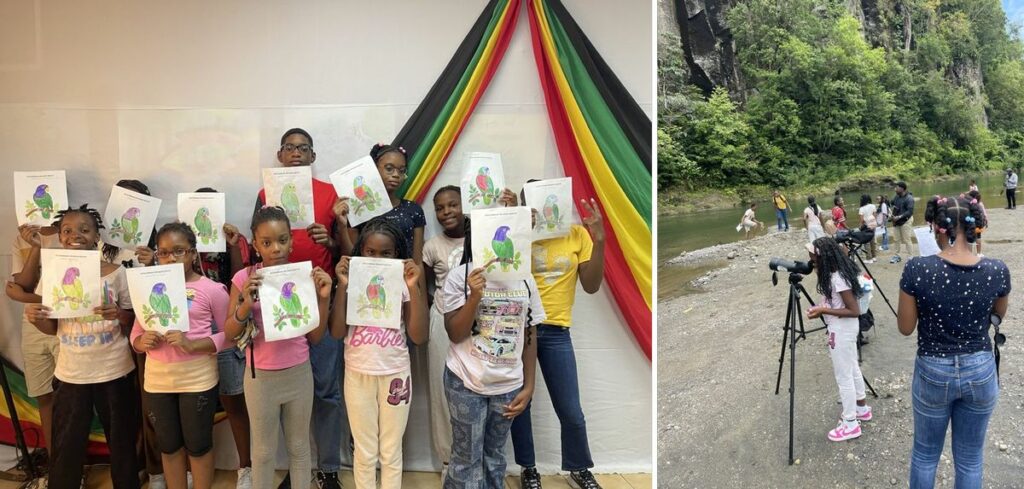
By combining learning with direct experience of nature, these activities aim not only to develop identification skills, but also to help young Dominicans better understand the exceptional biodiversity around them and the importance of protecting it.
And this is only the beginning
The educational component of the project is now entering a new phase. Lessons for primary and secondary school students are being prepared and will begin shortly, with activities continuing throughout the school year. The experience gained during the summer school will also help us refine these resources and adapt them to different age groups.
Work in the field is continuing as well. In the coming months, the project aims to further develop bird monitoring activities and progressively implement more concrete conservation actions for Dominica’s endemic parrots.
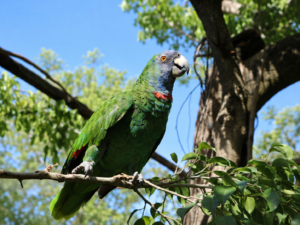
Red-necked Amazon
Another aspect of the project focuses on potential human–wildlife conflict, particularly the interactions between parrots and agricultural activities. A questionnaire was completed by 124 farmers in Dominica to better understand their perceptions of the impact of wildlife—particularly parrots—on their crops, as well as the potential effects of climate change on this issue. Analysis of the questionnaire will make it possible to better understand the significance of the conflict between farmers and parrots, as well as ways to mitigate it.
From improving scientific knowledge to involving younger generations, these complementary activities all contribute to the same objective: supporting the long-term conservation of the Sisserou and Dominica’s unique natural heritage.
Looking beyond the current project
The work currently underway in Dominica is also laying the foundations for a broader ambition. Building on this pilot project, Caribaea Initiative aims to develop, from 2027 onwards, a regional programme dedicated to the study and conservation of Caribbean endemic Amazon parrots.
The next phase would expand conservation work in Dominica to include the Red-necked Amazon, or Jaco, while also supporting a new programme for the Hispaniolan Amazon in the Dominican Republic. It would also contribute to improving facilities for the care and rehabilitation of parrots in the Caribbean islands and strengthen cooperation between researchers, conservation practitioners, forest officers and other specialists working across the Caribbean.
This regional programme is currently seeking additional funding as part of the fundraising campaign launched by Caribaea Initiative Suisse. If you would like to help us take the next step in the conservation of Caribbean parrots, discover the project and how to support it here.

The SCCS project is implemented by Caribaea Initiative and EcoBalance Inc., in collaboration with Dominica’s Forestry, Wildlife and Parks Division, with support from the Critical Ecosystem Partnership Fund (CEPF).